Frequently Asked Questions about ANCs
What is an ANC?
The term “ANC” stands for Advisory Neighborhood Commission. It is a non-partisan neighborhood body comprising several locally elected representatives called Advisory Neighborhood Commissioners. ANCs were established as part of the District’s Home Rule Charter and are a unique form of grass-roots local representation in the District since 1976.
According to the District’s Office of Advisory Neighborhood Commissions, the main purpose of ANCs is to be their neighborhood’s voice in advising the District government and Federal agencies on issues that affect their neighborhoods. To quote the office:
Although they are not required to follow the ANCs’ advice, many District agencies are required to give the ANCs’ recommendations “great weight.” Moreover, District law says that agencies cannot take any action that will significantly affect a neighborhood unless they give the affected ANCs 30 days advance notice. This includes zoning, streets, recreation, education, social services, sanitation, planning, safety, budget, and health services.
As of 2024, there are 46 ANCs in the District.
Where is ANC 3/4G?
For purposes of administering the government, the District of Columbia is geographically divided into 8 regions called Wards. Each Ward comprises several ANCs (indicated by letters A, B, C, etc) which advise the DC councilors in that Ward. Each ANC generally covers anywhere from 2 to 10 neighborhoods, with each neighborhood containing about 2000 residents.
While ANCs usually belong to a single Ward, ANC 3/4 G is special in that it spans parts of both Wards 3 and 4. It represents the Barnaby Woods, Hawthorne and Chevy Chase areas of the city. It is broken down further into 7 subdistricts, called Single Member Districts, with a single commissioner coming from each subdistrict.
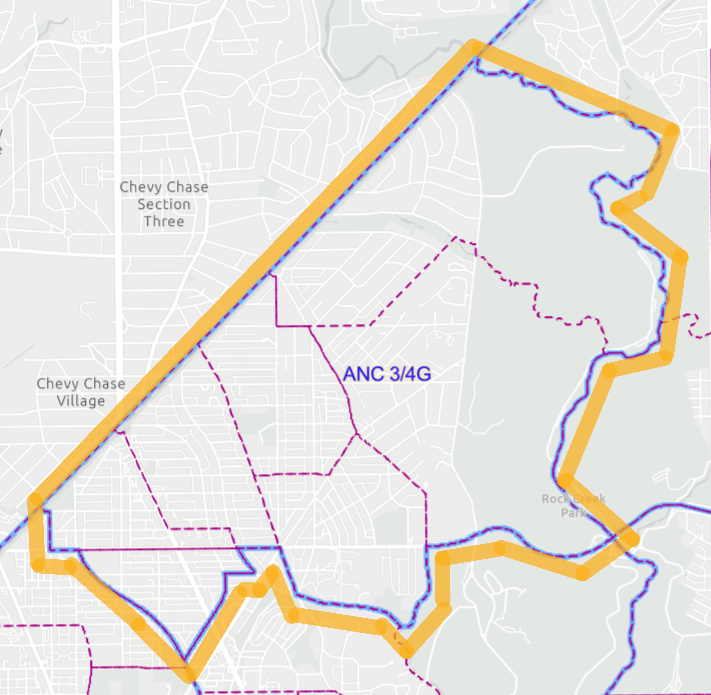
In the map below, the outer borders of ANC 3/4G are highlighted. The pink lines illustrate how the ANC is broken down into subdistricts (SMDs). The ANC is bordered by Western Avenue on the northwest, Rock Creek Park on the east and streets below Military Avenue on the south.
What is an SMD?
The abbreviation SMD stands for Single Member District and it represents a neighborhood of approximately 2000 people who elect a single representative to serve as a commissioner in their ANC.
Each ANC comprises anywhere from 2 to 10 SMDs, depending on the ANC’s population. An ANC Commissioner who represents an SMD must reside in that SMD.
As of 2024 there are 345 SMDs in the District.
Where is the SMD Liz would represent (SMD07)?
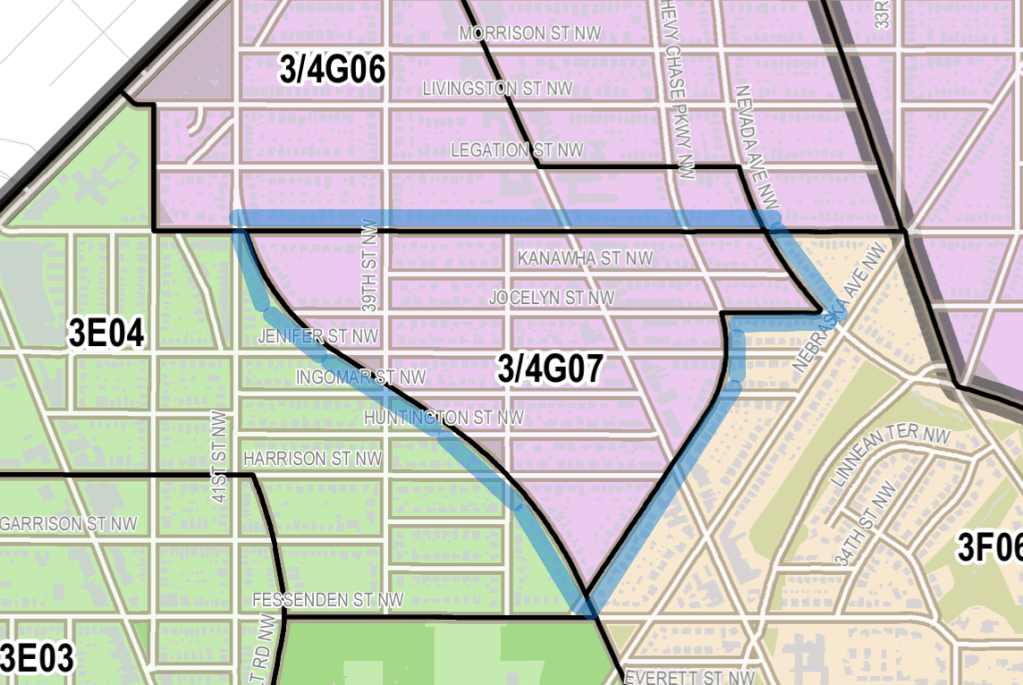
The SMD Liz is running for is the 7th SMD located in ANC 3/4 G. The map below depicts several ANCs (3E in green, 3F in yellow, 3/4G in pink). It shows the outline of SMD07 in the center. The SMD is bounded by Military Road on the north, Reno Road on the west, and by Chevy Chase Parkway (essentially on the south) and Nevada Ave. on the east.
What is the role of an ANC Commissioner?
ANC Commissioners are representatives of the smallest geographical units in District government (representing only about 2,000 residents with their SMD, versus the 80,000 residents typically found in a councilor’s ward) . As such, they are uniquely positioned to have close and direct involvement in issues within their SMDs, often being within a short walking distance of most of their constituents. This proximity enables them to have intimate knowledge of local issues and maintain close relationships with community members. The DC Council relies on ANC Commissioners to communicate neighborhood concerns and perspectives on every local issue from trash removal, schools, social services, liquor licenses, and zoning changes (just to name a few). The commissioners are also in an excellent position to help communicate and educate the local community regarding Council activities, District legislation, and city-wide initiatives that may affect their neighborhood.
By serving as the eyes, ears, and voice of their communities, ANC Commissioners ensure that the needs and concerns of their neighborhoods are represented in the city’s governance and decision-making processes.
Are ANC Commissioners Paid?
While the ANC commissioner position is an elected one, it is not a paid position. ANC commissioners are expected work out of a sense of duty and connection to their local communities.
Where Can I Learn More About My ANC?
A great place to start is this website maintained by the Office of Advisory Neighborhood Commissions.
To determine which ANC or SMD you belong to, visit this interactive map.
To see a list of who the ANC Commissioners are in 3/4G, visit this page.
Tell Liz What You Think!
Want to know more about how the ANC works? Do you have a concern related to SMD07? Drop Liz a line!
 Elizabeth Nagy for ANC 3/4G07